
Hertsmere households put out 6.31kg of refuse a week, the most of any Hertfordshire district, and a county study found food is the biggest thing in the bin.
Somebody has been through Hertfordshire’s bins and weighed what was in them, and Hertsmere came out with the fullest black bin in the county.
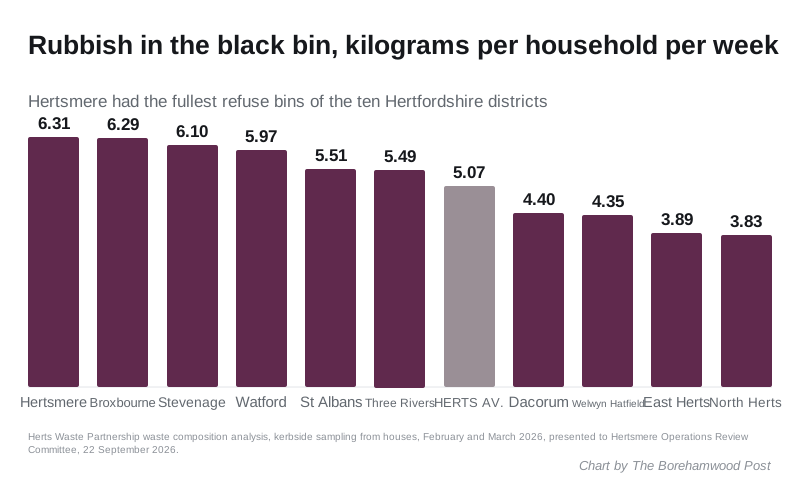
Households here put out 6.31kg of refuse a week, against a Hertfordshire average of 5.07kg. That is the highest of the ten districts and boroughs, just ahead of Broxbourne on 6.29kg. At the other end, North Herts households put out 3.83kg, barely three fifths of what Hertsmere does.
The figures come from the Herts Waste Partnership waste composition analysis, which went to Hertsmere’s Operations Review Committee on 22 September. Contractors sampled kerbside waste from houses across the county in February and March 2026 and sorted it by material. Dividing the weights by the number of houses sampled gives the figure per household per week.
The biggest thing in the bin is food
Look at the study’s chart of what is inside a Hertsmere refuse bin. The largest single band, by a distance, is kitchen organic. That is food.
The council has said as much itself. When it launched weekly food waste collections, its announcement said “up to a quarter of the black refuse waste collections being food”.
That launch matters for reading these numbers. Weekly food waste collections started in Hertsmere on Monday 7 April 2025. Almost 39,000 households were given a 23 litre silver bin and a roll of liners in the months before it. The county’s sampling then took place in February and March 2026, ten to eleven months into the new service.
So this is not a picture of Hertsmere before the silver bin. It is a picture of Hertsmere with the silver bin already running.
Recycling: less in, and more of it in the wrong bin
The same study looked at what is in the brown bin. Hertsmere households put out 2.98kg of dry recycling a week, below the county average of 3.29kg. Three Rivers managed 4.97kg.
The slides then combine the two to produce a capture rate: of all the recyclable material a household throws away, the share that ended up in the right container. Hertsmere’s is 44 per cent. The county ranking:
- North Herts, 60 per cent
- East Herts, 57 per cent
- Three Rivers, 54 per cent
- Dacorum and St Albans, 52 per cent
- Welwyn Hatfield, 51 per cent
- Hertsmere and Stevenage, 44 per cent
- Watford, 43 per cent
- Broxbourne, 40 per cent
The previous study, in September and October 2020, put Hertsmere at 62 per cent. Looking only at the core dry recyclables, paper, card, metals, glass and plastics, Hertsmere has gone from 63 per cent captured in 2020 to 51 per cent in 2026.
Those drops need the authors’ own health warning attached. The 2020 study ran in early autumn, so it caught far more garden waste, which flatters a recycling figure, and it ran mid-pandemic when households were generating more waste of every kind. The slides say residual waste is “less affected by the seasons, so is the most important bit to compare”.
On that measure, the study singles out five authorities that have cut dry recyclables in their residual waste to 2kg per household per week or less:
- Dacorum
- East Herts
- North Herts
- Stevenage
- Welwyn Hatfield
Hertsmere is not one of them.
Flats were looked at separately
The contractor could not calculate a per-household figure for flats, because it does not know how many flats were using each set of communal bins.
What it could measure was the mix. As a share of the bin by weight, food waste is five percentage points higher in flats than in houses.
Hertsmere runs a separate collection arrangement for flats, and the pattern can differ from the street rounds.
What happens to the study
Not a great deal, at least not here. The final slide promises three things:
- further analysis by the Herts Waste Partnership
- food waste messaging through the county-wide WasteAware programme
- the slides going to the October Operations Scrutiny Committee
Then this line: the study “provides a strong evidence for future service design which will now be a matter for consideration by new Unitary Authorities”.
In other words, the decisions this evidence points to will be taken by the South West Hertfordshire unitary council, which takes over from Hertsmere, Three Rivers and Watford in April 2028. The slides also flag three national changes coming at the same time: extended producer responsibility, the deposit return scheme and the emissions trading scheme.
What it means for you
Nothing in the study changes a collection day. What it does is put a number on something most households can check in their own kitchen.
If you want to move your own bin off the wrong end of that chart, the practical points are:
- The silver bin is weekly and free. It takes plate scrapings, stale bread, mouldy food, tea and coffee bags, meat, fish and bones: everything food except the packaging.
- Kitchen caddies are free too. You can collect one from the Civic Offices or 96 Shenley Road in Borehamwood, Wyllyotts Theatre in Potters Bar, Aldenham Parish Council in Radlett, or Bushey Grove Leisure Centre.
- Liners are optional. Any plastic bag except a black one works, because the processing plant strips the bag out first.
- Food in the green bin stops it being emptied, because garden waste goes to open windrow composting and food goes to a different plant.
- The brown bin takes glass, plastic, cans and tins, cartons, cardboard and paper. The 44 per cent figure above is mostly about material that went in the black bin instead.
Our full guide to the four bins, the two-week cycle and the £55 garden waste charge is in Borehamwood bin collection days.
Sources
- Herts Waste Partnership, Waste composition study, presented to Hertsmere Borough Council Operations Review Committee, 22 September 2026, for the sampling dates, the kilograms per household per week by district, the dry recycling figures, the capture rates for 2026 and 2020, the flats comparison and the next steps.
- Hertsmere Borough Council, Operations Review Committee, 22 September 2026, agenda and reports pack.
- Hertsmere Borough Council, Waste and Recycling changes start early April, 31 March 2025, for the 7 April 2025 start, the 39,000 households, the silver bin and the “up to a quarter” figure.
- Hertsmere Borough Council, Food waste, for what the silver bin takes, the caddy collection points and the liner rule.
Have your say